The economics of running a marketing agency have always been tight. Revenue scales with headcount, headcount scales with clients, and somewhere in the middle there is the margin problem. Adding a client m# How Marketing Agencies Are Using AI to Deliver More for Less
Marketing agencies have always had to balance two things: doing great work for clients and keeping the work profitable.
The problem is that marketing takes a lot of time.
Research takes time. Writing takes time. Creating social media posts takes time. Editing videos takes time. Reporting takes time. When an agency adds more clients, it often needs more people to handle all of that work.
AI is changing this model.
Instead of using AI to replace the people doing marketing, many teams are using it to remove repetitive work and give their people more time to focus on ideas, strategy, clients, and creative work.
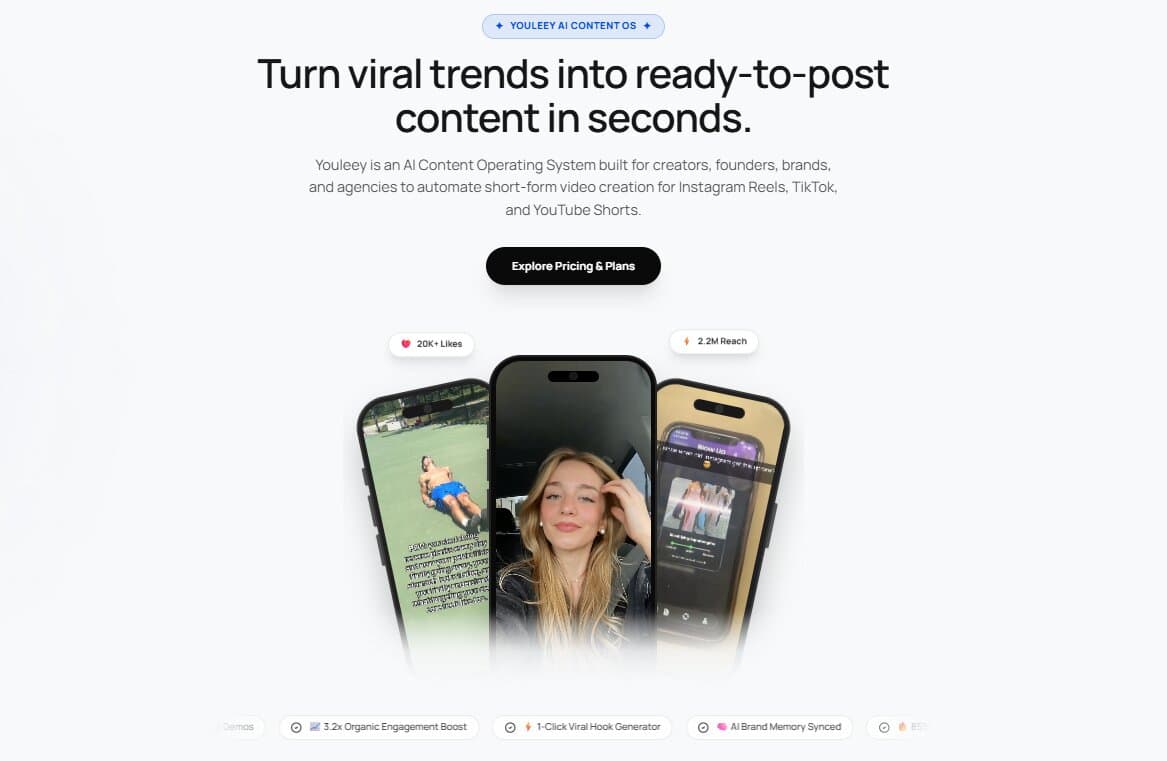
Tools such as Youleey are part of this shift. Youleey brings several short form content tasks into one workflow, including finding useful video patterns, creating hooks and scripts, remixing video ideas, creating content, and managing social publishing.
The result is a different way for agencies to think about delivering marketing services.
Why agencies are turning to AI
The demand for content keeps growing.
Clients want more social media posts, more videos, more ads, more blog content, and more ideas. At the same time, most agencies cannot simply keep hiring more people every time a client asks for more content.
Recent research from HubSpot found that 91 percent of marketing leaders said teams at their organization use AI to help with their work. The same research found that 82 percent of marketers said their company had invested in automation tools.
This does not mean agencies are handing their entire marketing process to AI.
Instead, they are using AI for the parts of the process that take a lot of time but do not always require a person to start from zero.
Here are some of the biggest areas.
1. Faster content research
Before creating content, marketers need to know what people are watching and talking about.
An agency might spend hours looking through TikTok, Instagram, YouTube, competitor pages, and industry content to find useful ideas.
AI can make this process faster.
For example, an agency can use AI to look for:
- Popular content formats
- Common hooks
- Topics getting attention
- Competitor content patterns
- Questions people ask
- Different ways to present the same idea
The important part is that AI should not simply copy another creator's content.
The better use is to understand what makes an idea work and then create something original for the client.
2. Creating more social media content
Social media is one of the clearest examples of where AI can help agencies do more with the same team.
A single idea can become several pieces of content.
For example:
One client idea can become:
- An Instagram Reel
- A TikTok video
- A YouTube Short
- A carousel
- A LinkedIn post
- Several social captions
- Different hook variations
HubSpot's research found that content creation is one of the most common ways marketers use generative AI. It also found that marketers use AI for research, brainstorming, data analysis, and other marketing tasks.
This gives agencies a simple advantage.
They can spend less time starting every piece of content from a blank page.
3. Making video production easier
Short form video has become an important part of marketing for many brands.
But creating a good short video can involve several steps.
Someone has to find the idea, write the hook, create the script, record or collect footage, edit the video, add text, create captions, and prepare it for publishing.
That can become expensive when an agency is doing it for multiple clients.
AI tools can now help with several parts of this process.
Youleey, for example, lets users analyze Instagram and TikTok videos, extract useful elements from those videos, create scripts and hooks, and remix video formats for their own brand. Its Content Studio also supports formats such as Hook and Demo videos, videos with text, AI presenter content, and carousels.
This can help an agency move from an idea to a usable content asset much faster.
The human still decides what the client should say and whether the final content actually feels right for the brand.
4. Reducing repetitive work
A lot of agency work is repetitive.
Creating similar reports every month is repetitive.
Writing similar captions is repetitive.
Resizing content is repetitive.
Creating different versions of the same message is repetitive.
Collecting information from different places is repetitive.
AI is useful when the task has a clear pattern.
Instead of asking a marketing manager to manually complete every small task, an agency can use AI to handle the first version.
The team can then review it, make changes, and move on.
This is where the real cost saving can happen.
The agency is not necessarily cutting people.
It is reducing the amount of time people spend on low value tasks.
5. Giving clients more content without adding another team
This is perhaps the biggest change for agencies.
Imagine an agency has a small social media team handling five clients.
If every client wants ten videos per month, the team needs to create fifty videos.
If the clients increase to ten, that becomes one hundred videos.
The old solution would usually be to hire more editors, writers, designers, or freelancers.
AI gives agencies another option.
They can automate parts of the production process and use their existing team to manage a larger amount of work.
This does not mean every AI generated piece will be good.
Human review is still important.
But when AI handles the first part of the work, the team can spend more time improving the content instead of building everything from scratch.
6. Personalizing content for different clients
Every client has a different voice.
A fitness brand should not sound like a software company.
A fashion brand should not sound like a finance company.
A marketing agency therefore needs to keep track of different audiences, products, offers, styles, and brand rules.
This is where brand focused AI tools can become useful.
Youleey has a Brand Memory feature designed to keep content connected to information such as the brand voice, audience, niche, values, offers, and positioning.
For an agency, this type of setup can make it easier to work across different clients without treating every project as if it were the same brand.
7. Faster testing
Marketing is rarely about creating one version and stopping there.
Agencies often need to test different ideas.
Which hook works better?
Which opening gets more attention?
Which message makes people keep watching?
Which format works better for a particular audience?
AI can make it easier to create multiple versions for testing.
For example, instead of writing one opening line for a video, an agency can create several different hooks and test them.
The goal is not to let AI decide what works.
The goal is to make testing faster.
What this means for agency pricing
AI is also changing how agencies can think about their costs.
Here is a simple example:
| Traditional workflow | AI assisted workflow |
|---|---|
| Research done manually | AI helps with research |
| One person writes every draft | AI creates a starting draft |
| Every video edited from scratch | AI helps speed up production |
| One idea becomes one asset | One idea can become several assets |
| More clients require more manual work | More parts of the workflow can be automated |
The exact savings will depend on the agency, client, team, and tools being used.
So it would be wrong to say that AI automatically makes every agency cheaper.
What it can do is reduce the amount of manual work required for many marketing tasks.
That gives agencies more room to decide how they want to use the saved time.
They might take on more clients.
They might offer more content.
They might spend more time on strategy.
Or they might simply give their existing team more breathing room.
AI does not replace the agency
This is an important point.
A marketing agency is not valuable simply because it can create content.
The real value comes from understanding the client, knowing the audience, finding the right message, building a strategy, and knowing what to do when something does not work.
AI cannot replace that human understanding.
It can help with the work around it.
The strongest model is therefore not human versus AI.
It is humans using AI to remove unnecessary work.
The future of agency work
Marketing agencies are moving toward a model where a smaller team can handle more of the production process.
Research can be faster.
Ideas can be generated faster.
Content can be produced faster.
Different versions can be tested faster.
Publishing can be easier.
This does not mean marketing will become completely automated.
In fact, the human side may become even more important.
When everyone has access to AI tools, simply producing more content will not be enough.
Agencies will still need good ideas, strong creative direction, clear brand thinking, and people who understand what the audience actually wants.
AI simply gives those people more time to do that work.
For agencies, that may be the biggest opportunity of all.
Instead of charging clients for hours spent doing repetitive work, agencies can focus more of their time on the work clients actually value.
And that is how AI can help marketing agencies deliver more without simply adding more people, more hours, and more cost to every project.
eans adding work. Adding work eventually means adding people. Adding people compresses margin. The model has always had this tension built into it.
AI is not a complete solution to that tension. But it is changing the math in ways that the agencies who adopt it early are already benefiting from.
This is about what is actually happening at agencies that have integrated AI into their content production workflows, and what the practical impact looks like.
The client volume problem
Most marketing agencies operate with a capacity ceiling. There is a maximum number of clients they can serve at their current team size before quality starts to slip. The ceiling is set by production capacity, not strategic capacity. Most agencies could handle the strategy side of more clients. They cannot handle the execution side.
Short-form video content is particularly labor-intensive in this context. Each client needs a consistent volume of content tailored to their brand, their audience, and their platform mix. A client on TikTok, Instagram Reels, and YouTube Shorts might need fifteen to twenty pieces of content per month to maintain any meaningful algorithmic presence. Multiply that across a book of ten to fifteen clients, and the production requirement becomes enormous.
The traditional solution was to hire more people. The AI solution is to extend the capacity of the existing team.
What changes when AI enters the agency production workflow
The most immediate change is scripting speed. A senior copywriter at an agency might spend two to three hours crafting a script for a client's short-form video, including ideation, drafting, revision, and client review preparation. With AI tools, that process compresses to thirty to forty-five minutes. The writer still does the strategic thinking and the final quality review. The AI handles the drafting and the variation generation.
Across fifteen clients and twenty videos per client per month, that time saving is substantial. It is the difference between a team being fully stretched and having capacity to take on additional clients.
The second change is production consistency. One of the hardest things in agency content production is maintaining quality and consistency across clients when the work is distributed among multiple team members. AI tools that are configured with client-specific brand profiles produce outputs that stay consistent with each client's voice and visual style, regardless of which team member is running the workflow.
In Kite, this is handled through Brand Memory. Each client gets a brand profile that stores their tone, their audience, their product context, and their content preferences. Every script and every video generated for that client draws on that profile automatically. The output feels like it was written by someone who knows the brand deeply, even on the first run.
Turnaround time and client expectations
Clients increasingly expect fast turnaround on content. A trend emerges on Monday. The client wants to respond by Wednesday. In the old workflow, Wednesday was ambitious. With AI tools in the production stack, Wednesday is achievable with time to spare.
This responsiveness is becoming a differentiator for agencies. The ones that can move fast on trend-based content, produce reactive content without sacrificing quality, and deliver consistent volume month after month are winning clients from agencies that cannot match that pace.
It is worth noting that the strategic work, the judgment calls about which trends are worth chasing for a specific client, which angles fit the brand, which content is ready to publish and which needs revision, still belongs entirely to the human team. AI speeds up the execution. The agency's expertise and judgment remain the actual product.
What agencies are specifically using AI for
Ideation at scale is one area. Generating fifteen to twenty content ideas for each client, across multiple platforms and formats, was previously a significant time investment. AI tools can produce a first-cut content calendar in minutes, which the team then refines, prioritizes, and adapts based on client knowledge.
Script drafting is another. Across multiple clients with different voices, the drafting work adds up fast. AI handles the first draft. The team handles brand alignment, tone calibration, and quality control.
Video production is the third. For clients who need short-form video at scale, AI tools that handle UGC generation, text-over-video composition, and hook plus demo assembly remove the need for a video production team for standard format content. The agency can deliver polished video content for multiple clients without a dedicated video editor for each account.
Format variation is the fourth. A single content idea can be produced in multiple formats, text-over-video, carousel, UGC-style talking head, quickly using AI. This multiplies the output from each brief without multiplying the work.
Pricing and positioning implications
Agencies that integrate AI effectively face an interesting strategic question. Do they pass the efficiency savings on to clients through lower pricing, or do they hold pricing and improve margins?
The smarter play is usually to hold pricing and improve both capacity and quality simultaneously. Rather than competing on cost with other agencies, position the AI capability as a production advantage. You can deliver more content, faster, at consistent quality, with faster response to trends. That is a value proposition most clients will pay full price for.
Some agencies are going further and packaging AI-powered content production as a specific service offering. A monthly content subscription that delivers a set volume of AI-assisted short-form videos per platform, with the agency providing strategy, brand management, and quality review. The client gets high-volume content at a price point that traditional agency production could not support. The agency gets a scalable, repeatable revenue model.
The limits worth acknowledging
AI does not replace the relationship management, strategic consulting, and account management work that defines a good agency relationship. Clients stay with agencies because of trust, expertise, and results, not because of production efficiency.
AI also does not replace senior creative judgment. Knowing which direction is right for a specific client in a specific moment, understanding the nuances of their brand, anticipating what their audience will respond to, these skills are still the agency's most valuable asset.
What AI does is remove the execution bottleneck that was previously preventing agencies from doing more of the high-value work. When production takes less time, more time is available for the strategic and relationship work that actually differentiates one agency from another.
The agencies that thrive with AI are the ones that stay focused on that distinction.