Coming up with content ideas is easy when something is already trending.
The hard part is finding the trend before everyone starts talking about it.
By the time a topic is everywhere on TikTok, Instagram, or YouTube, thousands of creators may already be making content about it. This is why finding trends early can give you a useful head start.
AI can make this process much easier.
Instead of spending hours scrolling through social media and saving random videos, you can use AI to look for patterns, study content that is getting attention, and turn those patterns into ideas for your own audience.
Tools such as Yuli, for example, can help you study viral videos, understand their hooks and formats, and turn those patterns into new content ideas that fit your brand.
Here is a simple way to use AI to find trending content before it becomes too crowded.
1. Start With What People Are Searching For
One of the easiest places to find early signals is search data.
Google Trends lets you see what people are searching for and how interest in a topic changes over time. It also has a Trending Now section that shows searches that are getting more attention than usual.
Instead of only looking for topics that are already huge, look for topics where interest is starting to rise.
For example, if you run a fitness brand, you could check topics related to:
- Home workouts
- Protein
- Running
- Weight training
- Fitness apps
- Recovery
You can then compare different topics and see which ones are gaining interest.
The important thing is to look for movement, not just popularity.
A topic that has been popular for years is useful, but a topic that is suddenly getting more attention may give you a better opportunity to create something early.
2. Watch TikTok Trends
TikTok has its own Creative Center where you can explore trending hashtags, videos and other creative signals.
TikTok's current Trends tool lets you filter trends by industry and time period. You can also open analytics for a hashtag to see its trendline, related videos, audience information and regional popularity.
This can help you answer a simple question:
What are people actually watching right now?
Do not only look at the biggest hashtag.
Look for smaller trends that are relevant to your audience.
For example, a marketing creator does not need to follow every trend on TikTok. They may get more value from watching trends around marketing, AI, startups, social media and business.
The closer the trend is to your audience, the easier it becomes to turn it into useful content.
3. Look for Patterns Instead of Copying Videos
This is where AI becomes especially useful.
When you find a video with strong performance, do not simply copy it.
Ask what made the video interesting.
Look at:
- The first few seconds
- The opening sentence
- The topic
- The video structure
- The visual style
- The length
- The way information is presented
- The ending
- The reason someone would keep watching
TikTok itself recommends using its Creative Center to find trends and creative examples, then thinking about how those trends can fit your own brand and audience.
AI can make this analysis much faster.
For example, instead of watching 50 videos and taking notes manually, you can use an AI tool to break down the common patterns.
You may discover that several unrelated videos are using a similar opening:
"I wish I knew this earlier."
The subjects are different, but the content structure is similar.
That is the useful insight.
You are not copying the video. You are learning the format.
4. Use AI to Find Repeated Content Patterns
A single viral video can be interesting.
Ten viral videos using a similar structure are much more interesting.
This is where you can start looking for patterns.
Ask AI questions such as:
- What topics appear most often?
- Which hooks are being repeated?
- What problems are creators talking about?
- Which formats appear across multiple videos?
- What questions are people asking?
- What type of opening keeps appearing?
- Which ideas could work for my audience?
The goal is to move from "This video is viral" to "This type of content seems to be working."
That difference matters.
A single viral video might be luck.
A repeated pattern gives you something you can actually study.
5. Use AI to Turn Trends Into Your Own Ideas
Finding a trend is only half the job.
You still need to make it relevant to your audience.
Suppose you notice that videos about "things I wish I knew before starting a business" are getting attention.
You could adapt the idea into:
5 things I wish I knew before launching a SaaS product
Or:
3 things I wish I knew before starting a content business
The original trend stays the same, but the topic becomes specific to your audience.
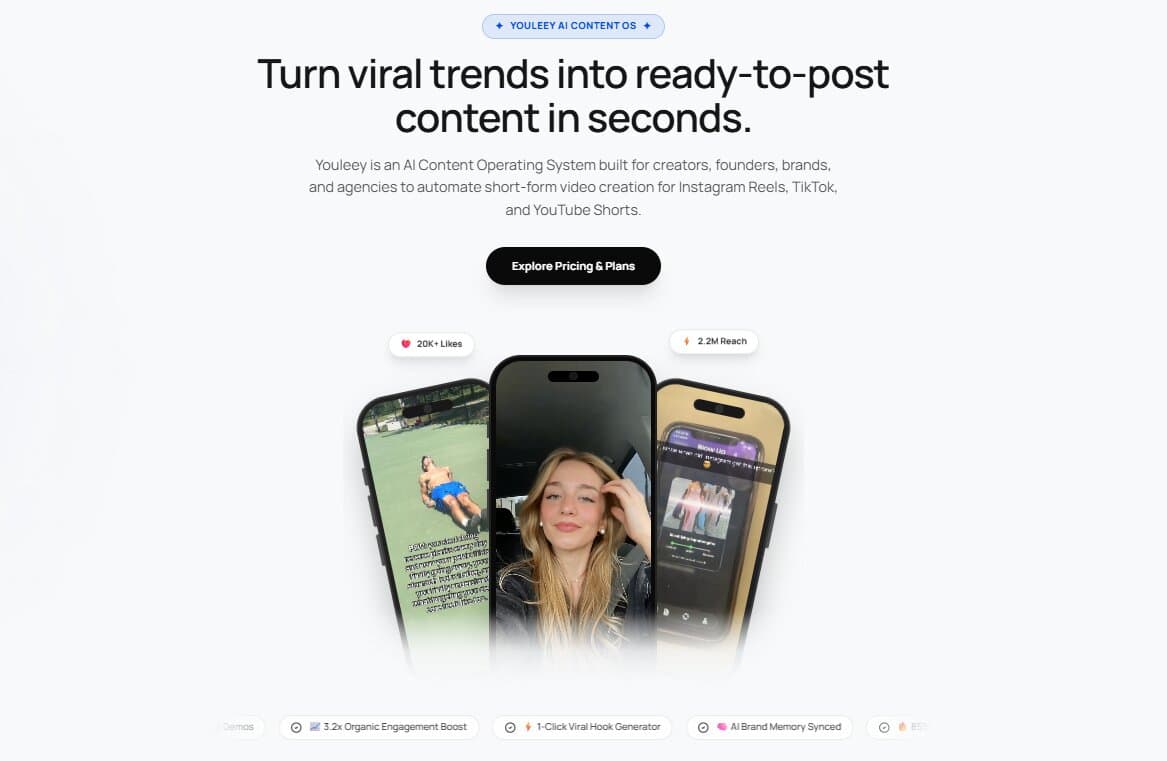
This is one of the useful ways to work with Youleey. Its current workflow lets users analyze viral Instagram and TikTok videos, extract elements such as hooks and scripts, and remix those ideas for their own brand. It also uses brand information to tailor the resulting content.
That makes the process more practical than simply asking an AI chatbot to give you 20 random content ideas.
6. Study Your Competitors
Your competitors can also show you what topics are getting attention in your industry.
Create a small list of accounts that consistently publish content for your target audience.
Then look for:
| What to check | What it can tell you |
|---|---|
| Recent videos | What they are talking about now |
| Strong hooks | How they get attention |
| Repeated topics | What their audience may care about |
| Video formats | How they package information |
| Posting patterns | When they tend to publish |
| Comments | Questions and problems from their audience |
Do not focus only on follower counts.
A smaller account can sometimes give you a better content idea because it may be experimenting with newer formats.
AI can help you compare several accounts and identify repeated patterns instead of manually checking every post.
Youleey's current Competitor Spy feature is built around signals such as competitor video feeds, hooks, performance analytics and posting patterns.
7. Find Trends Before They Become Mainstream
One useful approach is to look for signals at different stages.
Think about trends like this:
Early signal → Growing interest → Popular → Everywhere
Your goal is not always to find something at the very beginning.
That can be difficult and unpredictable.
Instead, look for topics that have started getting attention but have not yet become completely crowded.
You can use:
- Google Trends for search interest
- TikTok Creative Center for social trends
- Competitor accounts for industry signals
- Comments for audience questions
- AI for finding patterns across all of these sources
This gives you a much bigger picture.
8. Turn One Trend Into Multiple Content Ideas
Once you find something interesting, do not create just one post.
Turn the same idea into several angles.
For example, if you find a growing topic around AI marketing, you could create:
- A beginner's guide
- Common mistakes
- A personal experience
- A short tutorial
- A list of useful tools
- A myth versus fact video
- A reaction to the trend
- A case study
- A comparison
- A question based video
Now one trend has become ten possible pieces of content.
This is much more useful than constantly starting from a blank page.
9. Keep Your Human Point of View
AI can help you find patterns, but it should not replace your own ideas.
A trend can tell you what people are interested in.
It cannot automatically tell you what you should say.
Your experience, opinions, examples and stories are what make the final content different.
A good workflow is:
Find → Analyze → Adapt → Create → Test
Use AI to speed up the research and creation process, then add your own point of view before publishing.
Final Thoughts
Finding trending content before everyone else is not about predicting the future.
It is about paying attention to small signals.
Look at what people are searching for. Watch what is starting to gain attention on social platforms. Study successful videos. Look for repeated hooks and formats. Then use AI to connect those patterns to your own audience.
The biggest advantage is not simply knowing what is trending.
It is understanding why something is getting attention and knowing how to turn that insight into content that makes sense for your audience.
When you build this into your regular workflow, you spend less time asking, "What should I post today?" and more time creating content based on things people are already interested in.