Big brands have something most small businesses do not have: a large marketing team.
They can hire writers, designers, video editors, social media managers, researchers, and agencies to create content every day. A small business owner often has to do most of these things alone.
But the gap is getting smaller.
AI tools now give small businesses access to many of the same types of tools that were once only practical for companies with large marketing budgets. The goal is not to use AI to create hundreds of random posts. The real opportunity is to use AI to save time, understand what people want to watch, and create better content more consistently.
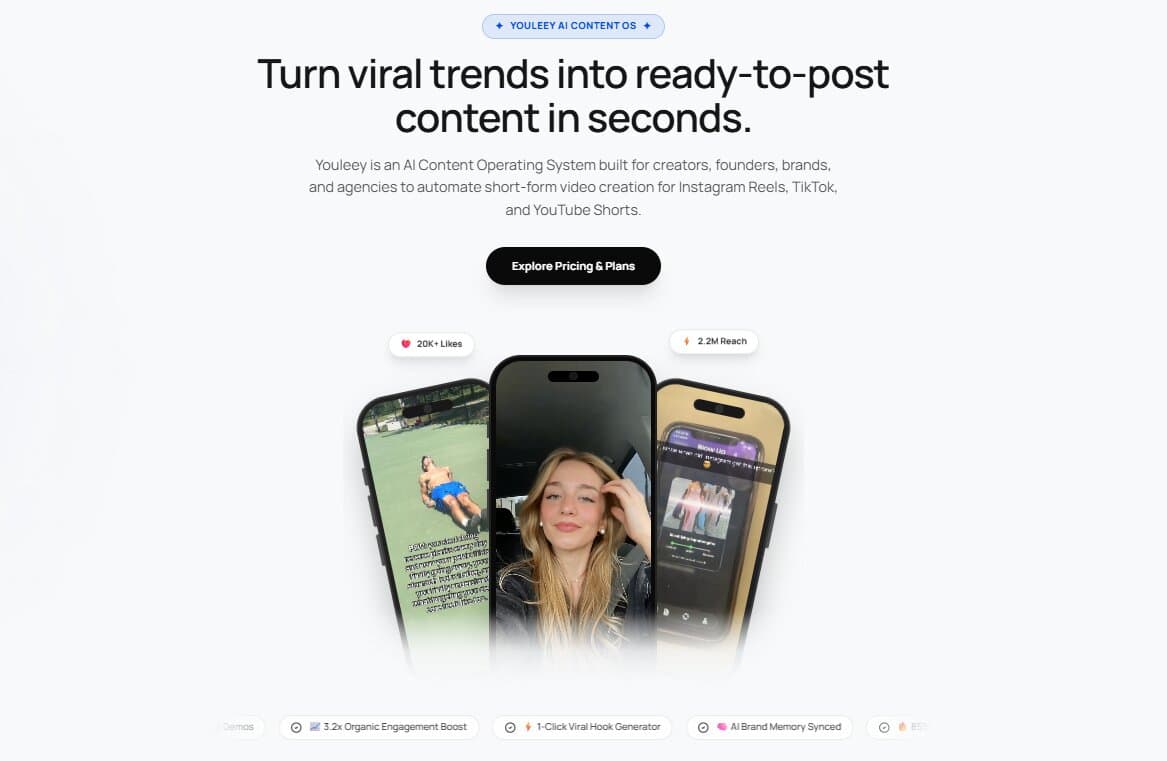
Tools such as Youleey are built around this idea. Youleey helps creators, founders, and marketers research short form content, find useful hooks, create scripts, analyze competitor content, and turn ideas into videos and other content formats.
So how can a small business actually use AI to compete with much bigger brands?
1. Find Content Ideas Faster
One of the biggest problems for a small business is simply knowing what to post.
You may have a great product, but that does not automatically give you 30 content ideas every month.
AI can help you research:
- Questions customers are asking
- Topics people discuss in your industry
- Popular content formats
- Common customer problems
- Competitor content
- Video ideas
- Social media hooks
- Different ways to explain your product
For example, imagine you run a small fitness software company.
Instead of constantly posting "Here are our features," you could use AI to find content ideas around problems your customers actually care about.
You might create content about saving time at the gym, tracking progress, staying consistent, or common mistakes people make.
The product can still be part of the content, but it does not have to be the entire story.
2. Study What Already Works
Big brands spend a lot of time testing content.
Small businesses can learn from that without having the same budget.
Look at successful videos and posts in your industry. Instead of copying them, study why they work.
Ask questions such as:
- What happens in the first few seconds?
- What is the main idea?
- How does the video start?
- Is there a question or problem?
- How quickly does it get to the point?
- What type of visual is being used?
- How is the product introduced?
This is where AI can save a lot of research time.
For example, Youleey can analyze reference videos and help identify things such as the opening hook, visual structure, and spoken content. You can then use those ideas to create something that fits your own business instead of simply copying another creator.
That difference matters.
The goal is not to copy another brand.
The goal is to understand what makes a piece of content interesting and then apply that lesson to your own audience.
3. Create Better Hooks
People see hundreds of pieces of content every day.
If the first few seconds do not give them a reason to continue watching, they may simply scroll past.
This is why the opening of a video matters so much.
AI can help a small business create different hooks for the same idea.
For example, instead of starting a video with:
"Today we are going to show you our new product."
You could try a more specific opening:
"Most small businesses waste hours doing this every week."
Or:
"We changed one thing in our content process and saved hours every week."
Or:
"If you run a small business, you probably know this problem."
The important part is that the hook should match the actual content. AI should help you explore different ways to present an idea, not make empty claims just to get attention.
4. Turn One Idea Into Multiple Pieces of Content
A small business does not always need more ideas.
Sometimes it needs to get more value from the ideas it already has.
Imagine you publish a video explaining one feature of your product.
That one idea could become:
- An Instagram Reel
- A TikTok video
- A YouTube Short
- A LinkedIn post
- A carousel
- A blog section
- An email
- A customer FAQ
AI can help turn the original idea into different formats.
This means your team spends less time starting from a blank page.
You can focus on the original idea and let AI help adapt it for different platforms.
5. Create Content Without a Large Production Team
Video used to require a camera, lighting, editing software, an editor, and a lot of time.
You can still create high quality videos that way, but AI has made the process much easier for small teams.
For example, a small software company can create a product demo using screen recordings and an AI generated structure.
A founder can also use AI to create a script before recording a video.
This can make content production much less intimidating for someone who is not a professional creator.
Youleey focuses heavily on this type of workflow, including product demo videos, scripts, hooks, carousels, and other short form content formats.
The advantage for a small business is simple.
You do not always need to hire a large creative team just to test a new content idea.
6. Use AI to Understand Your Competitors
Competitor research can take hours.
AI can make the process easier by helping you organize and study the content your competitors are publishing.
Instead of only asking what products competitors are selling, look at their content.
What topics appear again and again?
Which formats do they use?
What problems are they talking about?
How do they introduce their products?
What questions are they answering?
You may discover that your competitors are getting attention from topics that are only indirectly related to their products.
That can give you new ideas for your own content.
The goal is not to become a copy of your competitors. It is to understand the conversations already happening in your market.
7. Keep the Human Part of Your Content
This is probably the most important point.
AI can help you create content faster, but it should not remove your own experience from the content.
People still want to hear real stories, opinions, examples, mistakes, lessons, and experiences.
If you run a small business, you have something a large brand may not have.
You know your customers personally.
You understand their problems.
You have probably answered the same questions many times.
You have seen what works and what does not work.
Use AI to organize and improve that knowledge instead of asking AI to invent everything for you.
Google also recommends creating people first content that provides useful and original information rather than producing content mainly to attract search traffic. Google specifically warns against creating large amounts of AI content without adding value for users.
8. Build a Simple AI Content Workflow
You do not need dozens of AI tools to start.
A simple workflow can look like this:
Research → Ideas → Hooks → Script → Create → Review → Publish → Learn
Start by finding topics your audience cares about.
Then use AI to explore ideas and hooks.
Create the content.
Review it yourself.
Publish it.
Finally, look at which topics and formats performed well.
Then use those lessons for your next batch of content.
Over time, this creates a content system instead of forcing you to come up with something completely new every morning.
Small Businesses Do Not Need to Outspend Big Brands
The biggest advantage of AI for small businesses is not that it makes them look exactly like a large company.
It gives them the ability to move faster.
A small team can research an idea, create a script, make a video, test different hooks, and publish content without needing a large production department.
That does not mean every piece of AI generated content will work.
It will not.
The important thing is to use AI as part of your creative process rather than treating it as a replacement for your knowledge of your customers.
Big brands can spend more money on content.
Small businesses can use AI to make better use of the time and resources they already have.
And sometimes, having a smaller team can be an advantage. You can test an idea today, learn from your audience tomorrow, and change direction without going through five meetings first.
That is where AI becomes useful.
Not because it replaces the human behind the business, but because it gives that person more time to create, test, and focus on what actually matters.