Starting social media from zero is hard.
You have a new product, very few followers, no big audience, and probably a small marketing team. At the same time, you are expected to post regularly, create good videos, understand what people want to watch, and somehow get attention without spending a lot of money on ads.
This is where AI is changing the way startups approach organic social media.
Instead of spending hours coming up with content ideas, writing scripts, editing videos, and trying to understand what is working, startups can now use AI to speed up many parts of the process.
But there is an important point here.
AI does not replace good content. It makes it easier to create, test, and improve good content.
The old way of building social media
A small startup team might normally spend an entire day creating one short video.
First, someone needs to find an idea.
Then they write a script, record the video, edit it, add captions, find music, create a thumbnail, write the caption, and finally publish it.
If the video does not perform well, they have to start again.
Doing this once is manageable.
Doing it several times every week is where things become difficult.
AI gives startups a way to reduce the amount of manual work involved.
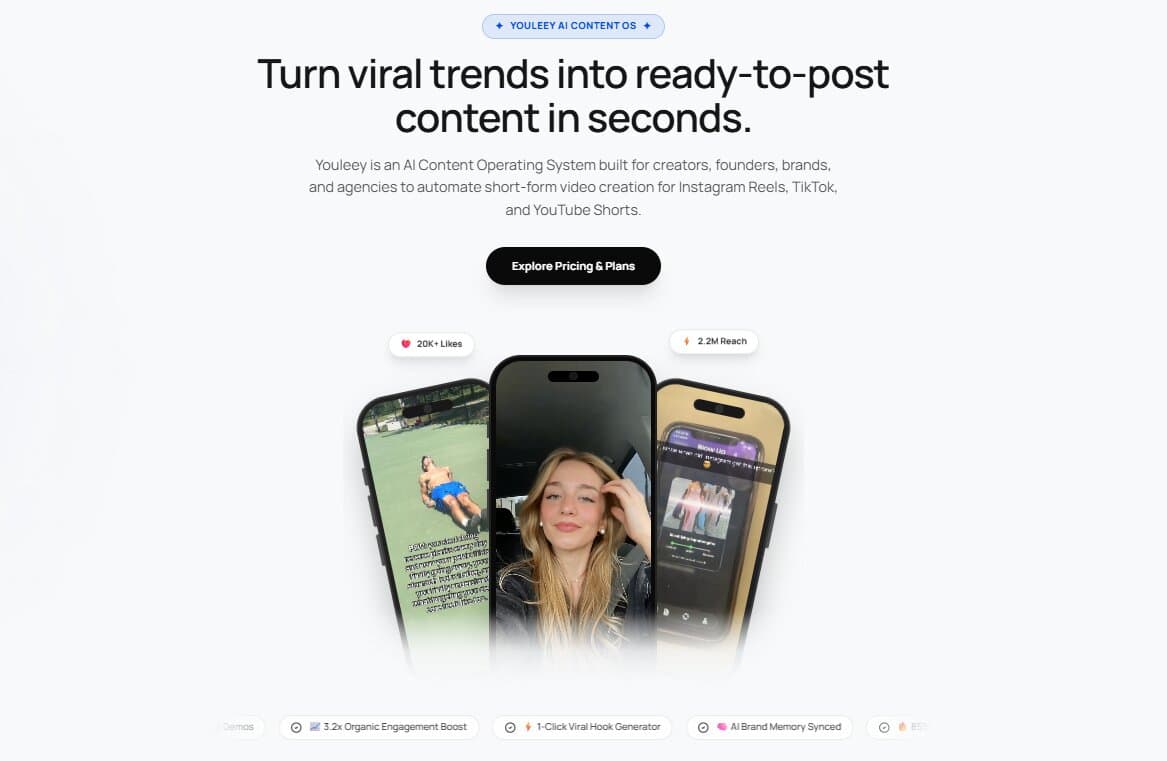
Tools such as Youleey, for example, are built around the short form content workflow. Youleey can analyze reference videos, identify hooks and formats, create scripts, and help turn ideas into ready to post content.
The bigger idea is not simply creating more AI content.
It is learning from what already works and making the content creation process faster.
Start with content research, not content creation
One of the biggest mistakes a startup can make is opening a blank document and asking:
"What should we post today?"
That usually leads to random content.
A better approach is to study the content that is already getting attention in your niche.
Look at:
- The first few seconds of popular videos
- Questions people repeatedly ask
- Problems customers talk about
- Product demonstrations
- Educational videos
- Founder stories
- Before and after examples
- Common mistakes
- Strong opinions within your industry
You are not trying to copy another creator.
You are trying to understand why a particular format works.
TikTok says its recommendation system looks at signals such as interactions, video information, and whether people watch content through to the end.
That means the first goal should not be getting millions of views.
The first goal should be creating content that gives people a reason to stop and watch.
AI can make content research much faster
This is one of the areas where AI can be particularly useful for small teams.
Instead of manually watching hundreds of videos and taking notes, AI can help break content down into useful parts.
For example, you can study a video and ask:
- What is the opening hook?
- What problem is being discussed?
- How is the story structured?
- What happens in the first three seconds?
- What makes the video easy to understand?
- Where does the product appear?
- What type of call to action is being used?
Youleey has a video analyzer designed around this type of workflow. It can break down a reference TikTok or Instagram video into elements such as the visual hook, spoken script, camera setup, and transcript.
This can be useful when you are starting from zero because you do not have your own large library of successful posts yet.
You can learn from existing content while developing your own style.
Turn one idea into multiple posts
Another way startups are using AI is to get more content from the same idea.
Imagine you have one product feature you want to explain.
You could turn that one feature into:
- A short product demo
- A founder talking video
- A problem and solution video
- A customer question
- A quick tutorial
- A list of common mistakes
- A comparison
- A text based Reel
- A carousel
- A story about how the feature was built
The goal is not to post the same thing over and over.
The goal is to look at one idea from different angles.
This gives startups more chances to discover what their audience actually responds to.
The hook matters more than most startups think
People do not open TikTok or Instagram because they are waiting to see your company announcement.
They are scrolling.
You have a very short amount of time to give them a reason to stop.
That is why the opening line and opening visual matter so much.
Instead of starting with:
"Today we are excited to announce our new feature."
Try starting with the problem.
For example:
"Most startups waste hours making videos nobody watches."
Or:
"We spent months building this, but this is what actually gets people to notice it."
The second approach creates curiosity.
AI can help startups generate different hook ideas around the same topic. You can then choose the ones that sound natural for your brand instead of simply publishing whatever the AI gives you.
Consistency becomes easier with AI
Organic social usually does not work because of one perfect post.
It is a process of publishing, learning, and improving.
A startup might discover that product demos work better than talking videos.
Another might discover that founder stories get more comments.
Another might find that educational content brings the right audience.
You cannot know this before testing.
AI makes testing easier because it reduces the time needed to create each version.
For example, instead of spending several hours producing one video, a startup can create several variations of the same idea and compare how people respond.
The important part is to use the results to make better content.
Do not just create more content for the sake of creating more content.
Do not let AI make your content sound like AI
This is probably the biggest warning for startups.
AI can write a perfectly structured script that nobody wants to watch.
It can sound too polished.
It can use words that people do not normally use.
It can make every video sound like the same company.
That is why human input still matters.
Give the AI real information.
Use customer questions.
Use actual product experiences.
Talk about things you learned while building the company.
Share mistakes.
Use your own way of speaking.
The more real information you give the system, the easier it becomes to create content that feels connected to your business.
Build a simple organic content system
Startups do not need a complicated marketing machine.
A simple system can look like this:
Step 1: Find ideas
Study your niche, customers, competitors, comments, forums, and existing social content.
Step 2: Find patterns
Look for topics, hooks, formats, and questions that repeatedly get attention.
Step 3: Create variations
Turn those ideas into several different content angles.
Step 4: Publish consistently
Post regularly across the platforms where your audience spends time.
Step 5: Study the results
Look at watch time, comments, shares, saves, clicks, and other useful signals.
Step 6: Repeat what you learn
Create more content around the ideas that are getting useful responses.
This creates a simple feedback loop.
Research → Create → Publish → Learn → Improve
AI can help speed up almost every part of this process.
Organic social is still about people
There is a temptation to think AI means startups can automate everything.
That is probably the wrong way to look at it.
The best use of AI is often removing repetitive work so the team can spend more time on the parts that require human judgment.
AI can help with research.
AI can help with ideas.
AI can help with scripts.
AI can help with editing.
AI can help turn one idea into multiple formats.
But the startup still needs to decide what it wants to say and who it wants to talk to.
That part cannot be outsourced to a button.
The real advantage for small startups
Large companies can hire content teams, editors, social media managers, designers, and agencies.
A startup may have two founders doing all of this themselves.
AI helps reduce that gap.
A founder can research content in the morning, create several ideas, turn the strongest ones into videos, and publish without needing a large production team.
That does not guarantee viral growth.
Nothing does.
But it can make the process much faster and give a small team more opportunities to find what works.
And that is probably the most useful way to think about AI and organic social.
Do not use AI to replace your voice. Use it to give your voice more chances to be heard.