You can spend hours making a great video, editing it, adding captions, and making everything look perfect.
Then you post it.
People scroll past it in seconds.
It feels frustrating, but the problem may not be your video. It may be your hook.
Your hook is the opening part of your video that gives people a reason to keep watching. On TikTok, Instagram Reels, and YouTube Shorts, the opening seconds are especially important because viewers can move to the next video with one quick swipe. Recent hook research also points to the importance of both the words people hear or read and what they see when the video starts.
So how do you write a video hook that makes someone stop scrolling?
Let’s break it down.
What Is a Video Hook?
A video hook is the first thing that grabs attention.
It can be a sentence you say.
It can be text on the screen.
It can be something interesting happening visually.
Or it can be a combination of all three.
For example, instead of starting a video with:
“Today I am going to show you our new product.”
You could start with:
“I wish I knew this before making my first 100 videos.”
The second version creates a reason to keep watching.
The viewer wants to know what you learned.
That small change can completely change how people react to the opening of your video.
Why Your First Few Seconds Matter
Think about how you use TikTok or Instagram.
You are not sitting there waiting patiently for every video to explain itself.
You are scrolling.
If something looks interesting, you stop.
If it looks boring, you move on.
That is why your opening needs to give people a reason to stay.
A strong hook does not have to be clever. It just needs to create interest.
You can do that with curiosity, a problem, a question, a strong opinion, a surprising result, or something your audience can relate to.
1. Start With a Problem Your Audience Has
One of the easiest ways to write a hook is to talk about a problem your audience already understands.
For example:
“Your videos may not be boring. Your hooks might be.”
“Still spending hours editing one Reel?”
“Getting views but no customers?”
“Posting every day and still getting no reach?”
These hooks work because they immediately speak to a real problem.
The viewer can quickly ask themselves:
“Is this about me?”
If the answer is yes, they have a reason to keep watching.
2. Create Curiosity
People naturally want to know what happens next.
You can use that in your hook.
For example:
“I changed one thing in my videos and noticed a huge difference.”
“There is a reason your best videos are not getting views.”
“Most creators make this mistake before they even start recording.”
“I tested five different hooks. Here is what I learned.”
Notice that these hooks do not explain everything.
That is the point.
They give the viewer just enough information to make them curious.
But there is an important difference between curiosity and clickbait.
Your video should actually deliver what the hook promises.
3. Ask a Question
Questions are simple, but they can work well when the question is relevant to your audience.
For example:
“Why do some videos get millions of views?”
“What makes someone stop scrolling?”
“Are you writing your hooks backwards?”
“Would you watch this video if you saw it on your feed?”
The best questions are questions your audience already thinks about.
A random question will not do much.
A question connected to a real problem can create immediate interest.
4. Give a Clear Result
Another simple approach is to tell people what they will get from watching.
For example:
“Here are five hooks you can use for your next Reel.”
“Here is how I write a video hook in under five minutes.”
“Three hook ideas for SaaS founders.”
“Here is how to turn one idea into ten videos.”
This approach works especially well for educational content.
The viewer knows what they are going to get, so there is less guessing involved.
5. Use a Strong Opinion
You do not always need a question or a promise.
Sometimes a strong opinion is enough.
For example:
“Your first line matters more than your fancy editing.”
“Stop starting your videos with your introduction.”
“More content will not fix a weak hook.”
“Most brands are making short form videos way too complicated.”
The important part is that the opinion should lead somewhere.
Do not say something controversial just to get attention.
Make sure the rest of the video gives the viewer something useful.
6. Make the Visual Hook Match the Words
Your hook is not only about what you say.
What people see matters too.
Imagine someone saying:
“This is the biggest mistake I made with my content.”
But the video starts with a still shot of someone sitting at a desk.
There is nothing wrong with the sentence, but the visual does not add much.
Instead, you could show the mistake immediately.
Show the screen.
Show the result.
Show the before and after.
Show the product.
Show something changing on screen.
Recent guidance on social video hooks highlights this difference between the written hook and the visual hook. Both can work together to create interest in the opening moments.
7. Keep Your Hook Simple
One common mistake is trying to say too much.
A hook is not your entire video.
Its job is to earn the next few seconds.
Compare these two openings:
“In today's video, I am going to discuss some of the different strategies that creators can use to improve their social media content and potentially increase engagement.”
Too much.
Now try:
“Your videos need better hooks, not more editing.”
Much easier to understand.
Simple usually wins.
Write your hook like you are talking to one person.
8. Write Multiple Hooks for the Same Video
Do not assume your first idea is your best idea.
Write five or ten versions.
For the same video, you could have:
“Why are people scrolling past your videos?”
“Your content may not be the problem.”
“Try this before posting your next Reel.”
“I tested five hooks. These were the ones I liked most.”
“Stop starting your videos like this.”
The main idea stays the same.
The opening changes.
This gives you more options and helps you find a hook that fits your content better.
9. Study Videos That Already Work
You do not have to create every hook from a blank page.
Look at videos in your niche that are getting attention.
Pay attention to the first few seconds.
What does the creator say?
What appears on screen?
How quickly does the video get to the point?
What problem is being discussed?
What makes you want to keep watching?
You are not copying the video.
You are studying the structure behind it.
For creators, this can save a lot of time.
Instead of guessing what type of opening to write, you can study patterns that are already being used in your niche.
How Youleey Can Help You Create Better Hooks
This is where tools like Youleey can make the process easier.
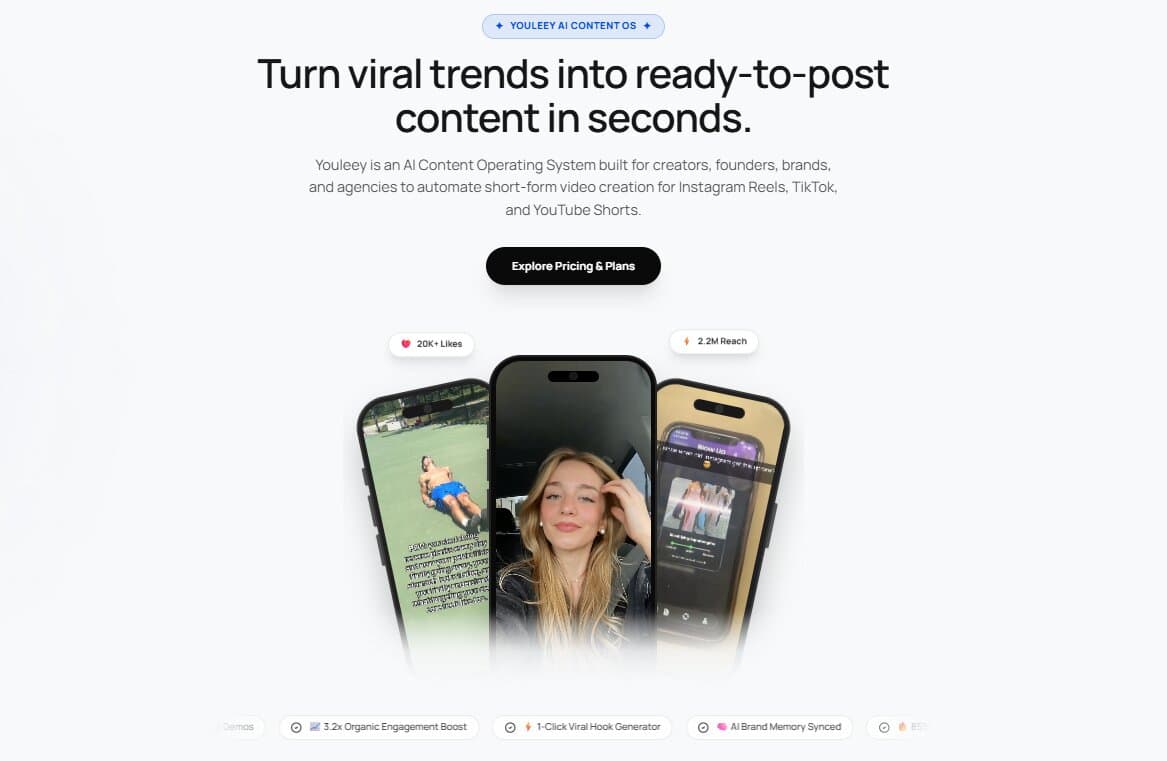
Youleey is an AI Content Operating System built for SaaS founders, apps, and creators. It can analyze Instagram and TikTok videos, identify their opening hooks and other parts of the format, and help remix those ideas into scripts for your own brand.
You can also add your website or brand so Youleey can learn about your audience and product. From there, you can choose content formats and generate hooks designed around your business.
For example, instead of spending an hour looking through videos and trying to figure out why their openings work, you can use Youleey to analyze reference videos and turn useful patterns into new content ideas.
You can also use its Script and Virality Studio to create ready to shoot scripts and multiple hook options.
The goal is not to let AI replace your ideas.
It is to remove the blank page problem.
You still decide what you want to say.
AI simply helps you get there faster.
A Simple Hook Formula You Can Use
If you are stuck, try this:
Problem + curiosity + promise
For example:
“Your Reels are not getting watched. Here is the hook change I would make.”
Or:
“Still spending hours making videos? Here is a faster way to create them.”
Or:
“People are scrolling past your content. Try this opening instead.”
Keep it clear.
Keep it short.
And make sure the video actually delivers on the promise.
Final Thoughts
A great video does not get a chance to perform if people never watch past the opening.
That is why your hook deserves more attention.
Start with a real problem.
Create curiosity.
Ask a useful question.
Show the result.
Keep the words simple.
Make the visual match the opening.
And most importantly, write more than one version.
You do not need to become a professional copywriter to create better hooks.
You just need to understand what makes someone think:
“Wait, I want to see this.”
That is the job of your hook.